Camera & Creator / PRODUCT GUIDE
Canon EOS R100 kit: the lens-upgrade path, with entry-level video limits
The EOS R100 is an interchangeable-lens APS-C camera bundled here with Canon’s compact RF-S 18–45mm zoom. We explain what the kit is good at, the autofocus and screen tradeoffs, and when a fixed-lens vlogging camera could be the simpler choice.
As an Amazon Associate I earn from qualifying purchases.
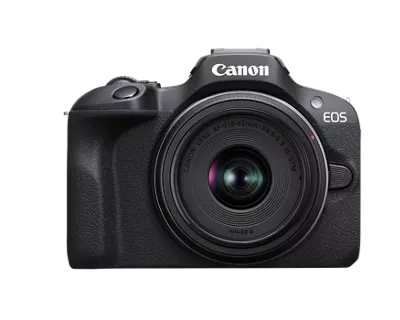
View Canon EOS R100 with RF-S 18–45mm F4.5–6.3 IS STM lens kit on Amazon (paid link) ↗
What the R100 kit gives you
This listing is the Canon EOS R100 body with the RF-S 18–45mm F4.5–6.3 IS STM zoom. Canon specifies a 24.1-megapixel APS-C CMOS sensor and DIGIC 8 processor. Unlike a phone or fixed-lens compact, the R100 accepts compatible RF and RF-S lenses, which gives you a path to a wider, longer, brighter, or more specialized lens later. That flexibility is also a future expense; the kit lens does not cover every kind of photography.
The 18–45mm kit lens is for everyday framing
Canon’s RF-S 18–45mm is a small retracting zoom for APS-C cameras, with optical stabilization rated by Canon at up to four stops. It covers a useful everyday range for people, travel, and general scenes, but its maximum aperture narrows from f/4.5 to f/6.3 as you zoom in. That is not a bright lens for dim interiors. It also cannot zoom as far as a telephoto lens, so check whether you routinely photograph distant sports, wildlife, or stage performances before assuming this single kit will cover them.
An electronic viewfinder is a practical advantage
The R100 includes a 0.39-inch OLED electronic viewfinder with about 2.36 million dots. Looking through it helps when bright sun makes a rear screen hard to see and can steady the camera against your face for still photos. The body also has a 3-inch rear LCD, but Canon specifies that it does not have touchscreen operation. The camera is therefore less phone-like for touch focus and menu navigation than a creator camera with an articulating touch display.
Autofocus is most capable for stills and Full HD
Canon lists Dual Pixel CMOS AF for stills and Full HD or HD movies, with face and eye detection. The important caveat is 4K: the R100 switches to contrast-detection autofocus, and Canon warns that focus may take longer or be difficult with certain lenses. If your priority is fast, dependable subject tracking while recording 4K, compare the R100 carefully with newer bodies or keep your clips in Full HD. For still photography, the eye-detection system and viewfinder make the R100 a more conventional camera experience than a pocket vlog camera.
4K video is available, but tightly defined
The R100 records 4K UHD at up to 24 frames per second from the central area of its sensor. That crop makes the field of view tighter than the lens markings alone suggest, and the slower contrast AF is a real workflow limitation for moving subjects. Canon also lists Full HD up to 60p and HD high-frame-rate recording up to about 120p. If 4K/60, uncropped 4K, or reliable continuous autofocus in 4K are essential, this is not the kit to buy on the strength of the words “4K” alone.
Plan for audio, cards, and stabilization
The R100 has a 3.5mm external microphone input and one SD-card slot. The kit lens has optical image stabilization, but Canon says the body itself has no in-body image stabilization. Stabilization therefore depends on the lens and recording mode; it is not a guarantee of smooth handheld video while walking. If the project needs moving-camera footage, budget for a support or stabilized lens and test the exact combination. One card slot also means there is no in-camera second-card backup.
R100 kit versus the Canon PowerShot V10
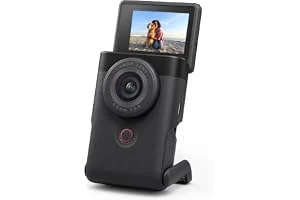
The PowerShot V10 is the smaller all-in-one option: one-inch sensor, fixed 19mm-equivalent wide lens, a built-in stand, flip-up screen, stereo microphones, and 4K recording. It gives up the R100’s electronic viewfinder, larger APS-C sensor, and lens changes. Choose the R100 if still photos and a future lens system matter. Choose the V10 if most of your work is direct-to-camera clips and you want a ready-to-place camera without building a kit.
R100 kit versus the Sony ZV-1
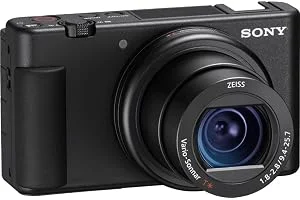
Sony’s ZV-1 is a fixed-lens creator compact with a one-inch sensor, a 24–70mm-equivalent f/1.8–2.8 optical zoom, a side-flip touchscreen, a directional three-capsule microphone, and a 3.5mm mic jack. It is more self-framing friendly than the R100, and its lens zooms without a crop. The R100 is the better starting point if you want an EVF, interchangeable RF lenses, and an APS-C still-photo kit. The ZV-1 is the more self-contained travel-video choice; neither replaces the other’s main advantage.
Who should buy the EOS R100 bundle
This bundle fits a first-time camera buyer who wants a viewfinder, a proper grip, strong still-photo potential, and the option to expand into other RF lenses. It is a sensible entry point if you are willing to learn the exposure controls and accept the kit lens’s range. Skip it if you mainly want a small camera for arm’s-length video, touch-friendly controls, or dependable autofocus in 4K. Canon’s product specifications inform this guide; Ryan has not represented this particular R100 kit as owned or tested.
Compare the shopping options
Canon PowerShot V10 — compare a pocketable fixed-lens camera with built-in stand
Sony ZV-1 — compare a one-inch creator compact with optical zoom and a flip-out screen
Sources and review basis
Researched November 18, 2026. Ryan’s own experience is attributed where supplied. Other judgments are buying advice based on the cited product information, not a hands-on comparison or laboratory test. Prices and availability are checked at the retailer.
- Canon U.S.A. EOS R100 product features: APS-C sensor, continuous shooting, video modes, viewfinder, and wireless transfer
- Canon U.S.A. EOS R100 support specifications: one SD slot, RF mount, sensor, video AF limits, fixed non-touch screen, and audio input
- Canon U.S.A. RF-S 18–45mm kit lens specifications and optical stabilization
- Sony U.S.A. ZV-1 official camera overview and comparison features
- Canon U.S.A. PowerShot V10 official features and specifications
- Dated Amazon Cameras & Photo snapshot identifying the exact EOS R100 kit listing