Tools & Home Improvement / PRODUCT GUIDE
IRWIN 1794469: one sliding head for everyday woodworking layout
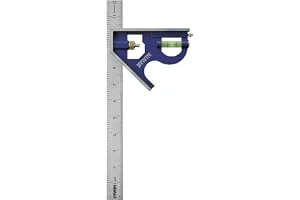
The twelve-inch IRWIN 1794469 combination square is useful when the job is making a mark you can actually cut or drill to. Its sliding head gives the ruler a repeatable relationship to a workpiece edge. That makes it a different purchase from a tape measure or digital angle gauge, even though all three can appear in the same measuring-tools search.
As an Amazon Associate I earn from qualifying purchases.
Buy it for physical references
IRWIN documents a cast-zinc body, a stainless-steel blade and etched scales. The head provides 90- and 45-degree marking references. Register the head against a clean, straight reference edge and draw along the rule. A rough or bowed edge can transfer its error to the mark, so selecting the reference face matters. This is particularly helpful when marking short boards or small assemblies where a flexible tape supplies a distance but cannot guide a perpendicular pencil line.
The sliding head helps repeat offsets
Set the rule projection to the desired distance and secure the head. You can then transfer the same offset to several locations without interpreting the tape afresh every time. This is useful for a consistent reveal, hardware layout or a line parallel to an edge, provided the reference edge is suitable. Make a sample mark and check it against the intended dimension before repeating it across the workpiece. A repeatable setting is valuable only when the initial setting is correct.
Twelve inches is a working size, not unlimited reach
A twelve-inch rule is convenient around smaller bench projects but cannot span every wide panel. Avoid extending a short pencil line by eye across a large sheet and assuming the far end remains square. Use an appropriate longer reference for that job. Likewise, the combination square’s ability to mark a right angle does not establish that every corner of a cabinet is square. Check the relevant faces and diagonals with tools suited to the assembly.
Check the tool before precision work
A useful practical check is to draw a line from a known straight edge, flip the square and compare the second line with the first. A visible divergence calls for investigation before using the tool for repeated cuts. Keep the sliding surfaces clear of sawdust and avoid using the rule as a pry bar. Ryan has not measured this particular square against a calibration standard. The article therefore does not claim machinist-grade accuracy or report a personal durability test.
Choose Klein 935DAF for an unknown angle
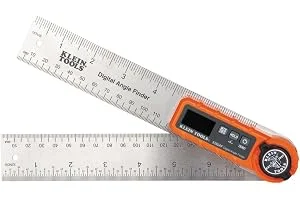
Klein’s hinged 935DAF B0CK37N65M can contact both sides of a corner and display its angle, with a simple miter calculation available. It is a better fit when existing trim must follow a corner that is not a standard right angle. The IRWIN is more direct for recurring fixed-angle marks and offsets. Choose the digital finder because you need to capture a variable angle, not because a display automatically improves every layout task.
Choose CRAFTSMAN’s full-length tape for dimensions
The CRAFTSMAN CMHT37225 B07QG3ZXQC provides a 25-foot flexible blade with printed fractions and a self-locking action. It is the more useful first tool for measuring a room, checking furniture width or planning material lengths. It does not replace the IRWIN’s rigid edge and registered head for marking a square cut. A practical small kit often needs both, but if the immediate job is only finding dimensions, buy the tape before adding a specialized layout tool.
Compare the shopping options
Klein 935DAF — capture nonstandard corner angles
CRAFTSMAN CMHT37225 — longer linear measurements

Sources and review basis
Researched November 20, 2026. Ryan’s own experience is attributed where supplied. Other judgments are buying advice based on the cited product information, not a hands-on comparison or laboratory test. Prices and availability are checked at the retailer.